


AmCham Focus
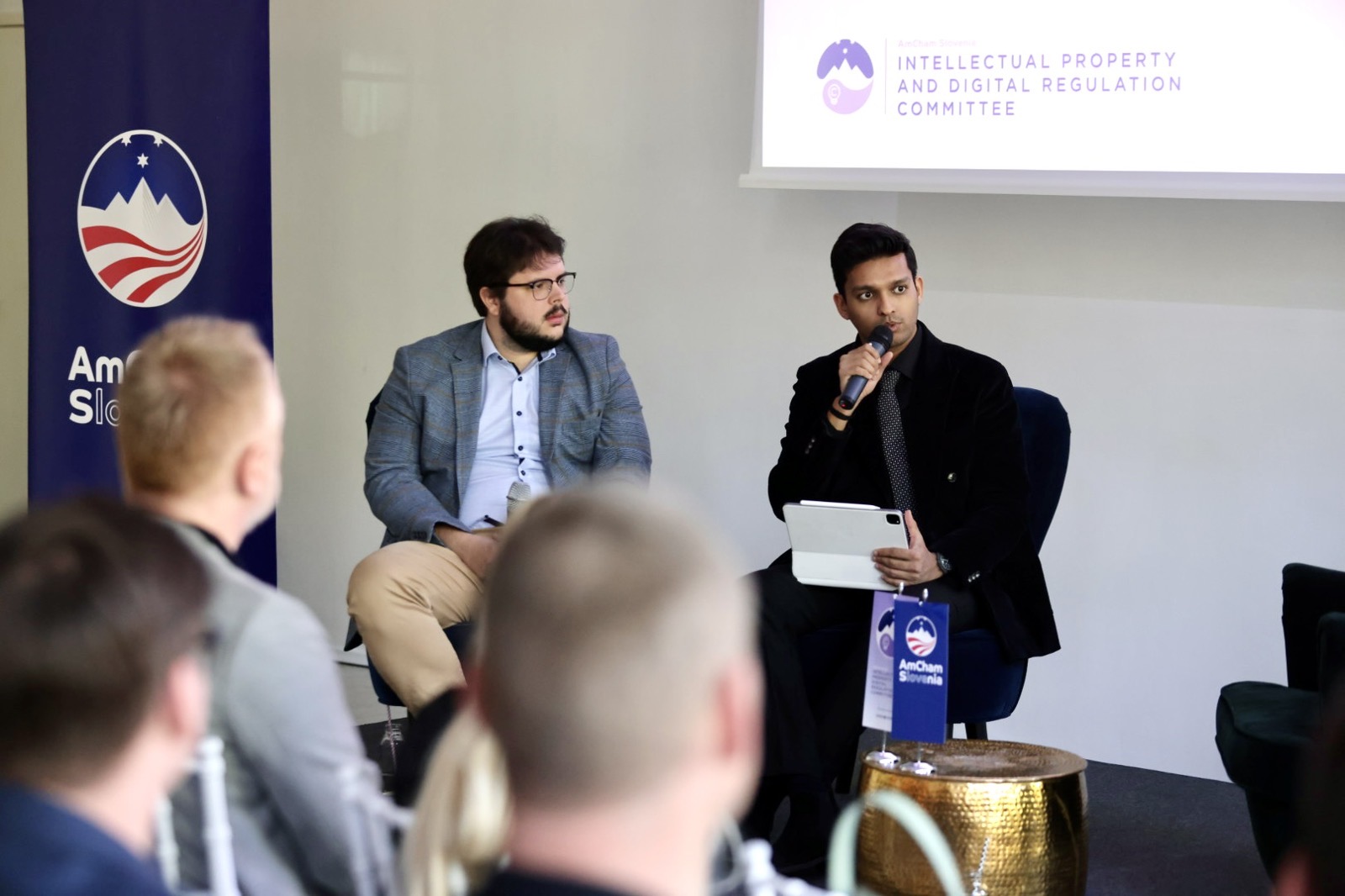
At the AmCham Focus event, which we organized together with the AmCham Intellectual Property and Digital Regulation Committee, we opened exactly this question: how companies, especially small and medium-sized enterprises, should navigate innovation, compliance, and an increasingly complex regulatory framework. Artificial intelligence is already here — not as a distant topic of the future, but as a concrete business issue: how to use it quickly, smartly, and responsibly in an environment where regulation is evolving almost as fast as the technology itself.
The discussion was moderated by Jaka Repanšek, RePublis and Co-Chair of the AmCham Intellectual Property and Digital Regulation Committee, who highlighted a key European paradox: Europe tends to regulate technologies before they become dangerous, while other jurisdictions often enable growth first and only then set the rules. As a result, innovation in Europe is increasingly arriving with a “legal user manual.” The key question therefore remains whether this approach builds long-term competitive advantage or creates an additional burden for businesses.
Luka Avbreht, co-founder and CEO of AFlabs, brought a development-focused perspective to the discussion: “Artificial intelligence is here. It exists. Prohibiting its use is a mistake.”
He emphasized that companies no longer need to debate whether to use AI, but rather how to use it. What matters most is understanding the concrete business problem and being able to connect the technology with actual processes — from industry to logistics.
Yash S. Bajaj, Foreign Legal Counsel, DevRev, highlighted the practical side of implementation: “If a solution is good, don’t overcomplicate it — use it.” At the same time, he warned that generic models do not create value on their own — companies need to adapt them to their specific use cases and integrate them into their own processes.
The discussion clearly showed that regulation is no longer a peripheral issue, but an integral part of product development. Companies need to understand, already in the early stages, which risk category their system falls into and what obligations this entails — regardless of company size. This is especially important for small and medium-sized enterprises, which form the backbone of the Slovenian economy but often do not have the same compliance resources as large systems.
An important part of the discussion was also devoted to legal uncertainty, particularly in the field of intellectual property. “When it comes to AI-generated content, key questions emerge: who actually owns the copyright and patent rights?”
This question remains open and will significantly shape the further development of both law and business practice.
The discussion also raised a broader question of competitiveness: does regulation encourage innovation, or primarily benefit those who can afford to implement it? At the same time, another perspective is gaining ground — that compliance itself can become a competitive advantage, especially when working with larger international partners.
The conclusion of the event was clear: companies need to start using artificial intelligence thoughtfully, but boldly. What will matter most is understanding the technology, building competencies, and ensuring that the regulatory framework does not become an obstacle, but part of the strategy.
The AmCham Intellectual Property and Digital Regulation Committee will continue to monitor the development of European digital legislation and artificial intelligence, while acting as a bridge between regulators and the business community, with the goal of helping shape a predictable, workable, and competitive digital environment.