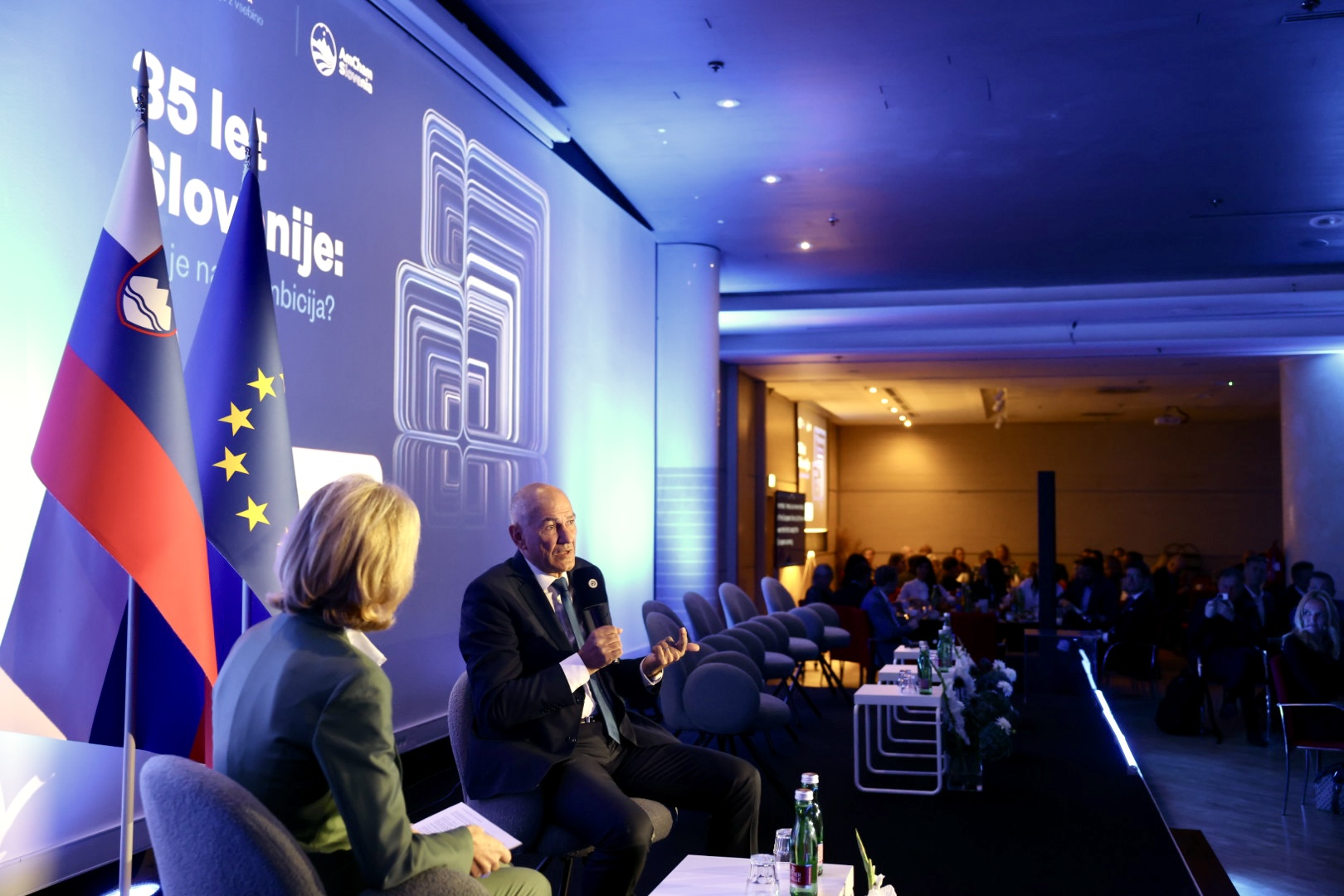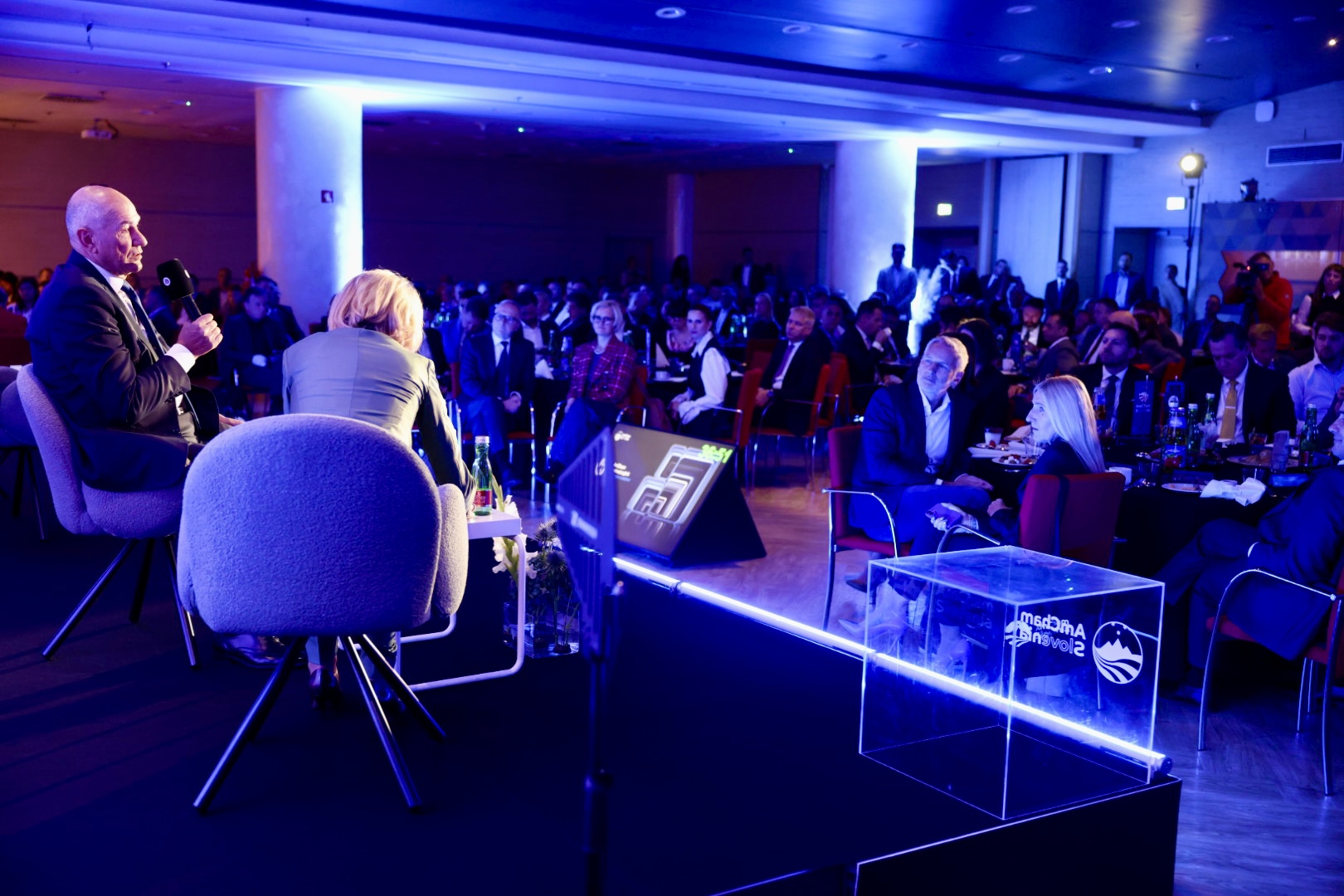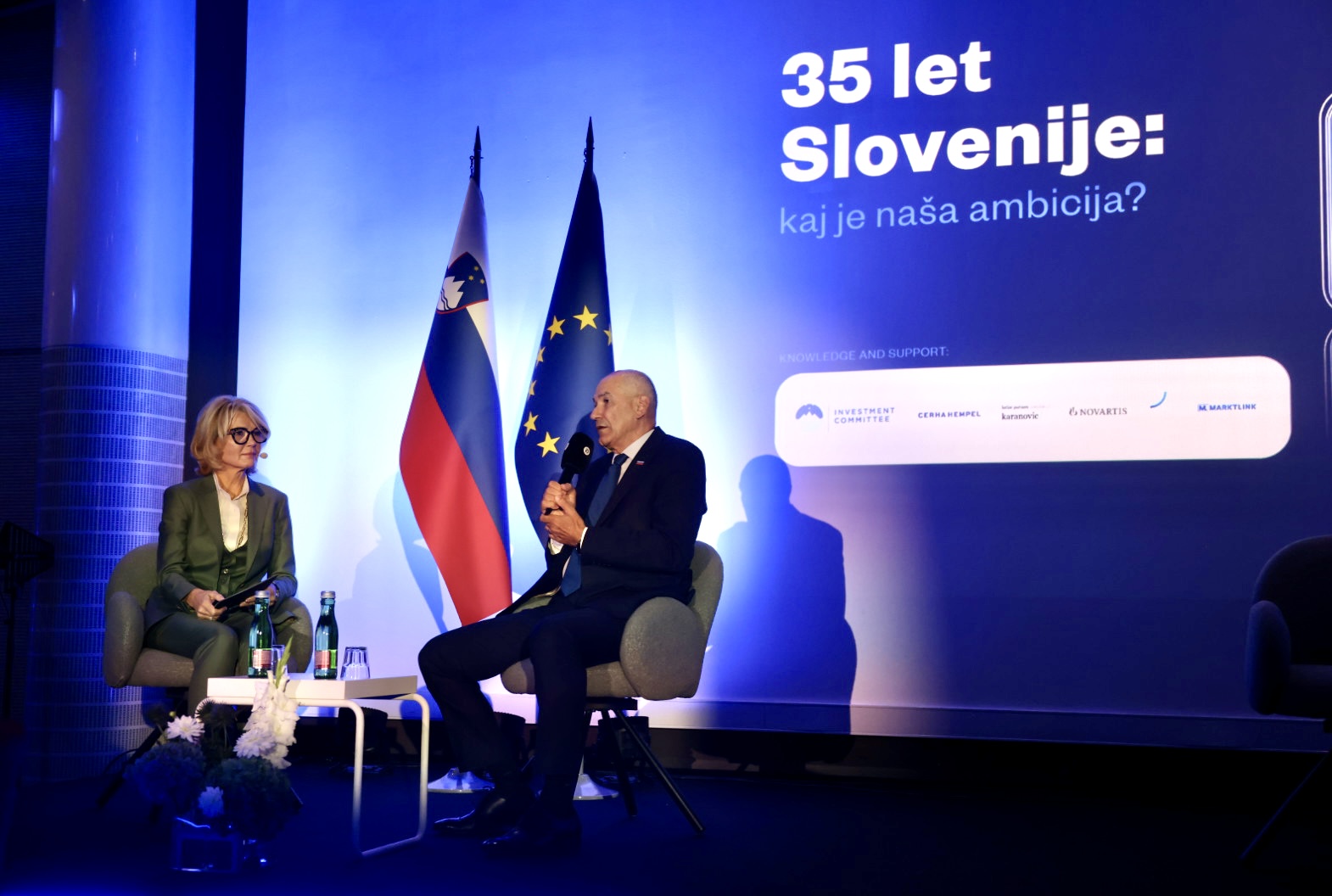


Ljubljana, 14 October 2026 – How can Slovenia turn its potential into a competitive advantage? How can it attract more domestic and foreign investment, retain and attract the best talent, and enable companies to grow from Slovenia into global markets? These were the central questions at the AmCham Business Breakfast “35 Years of Slovenia: What Is Our Ambition?”, whose keynote guest was Janez Janša, Prime Minister of the Republic of Slovenia.
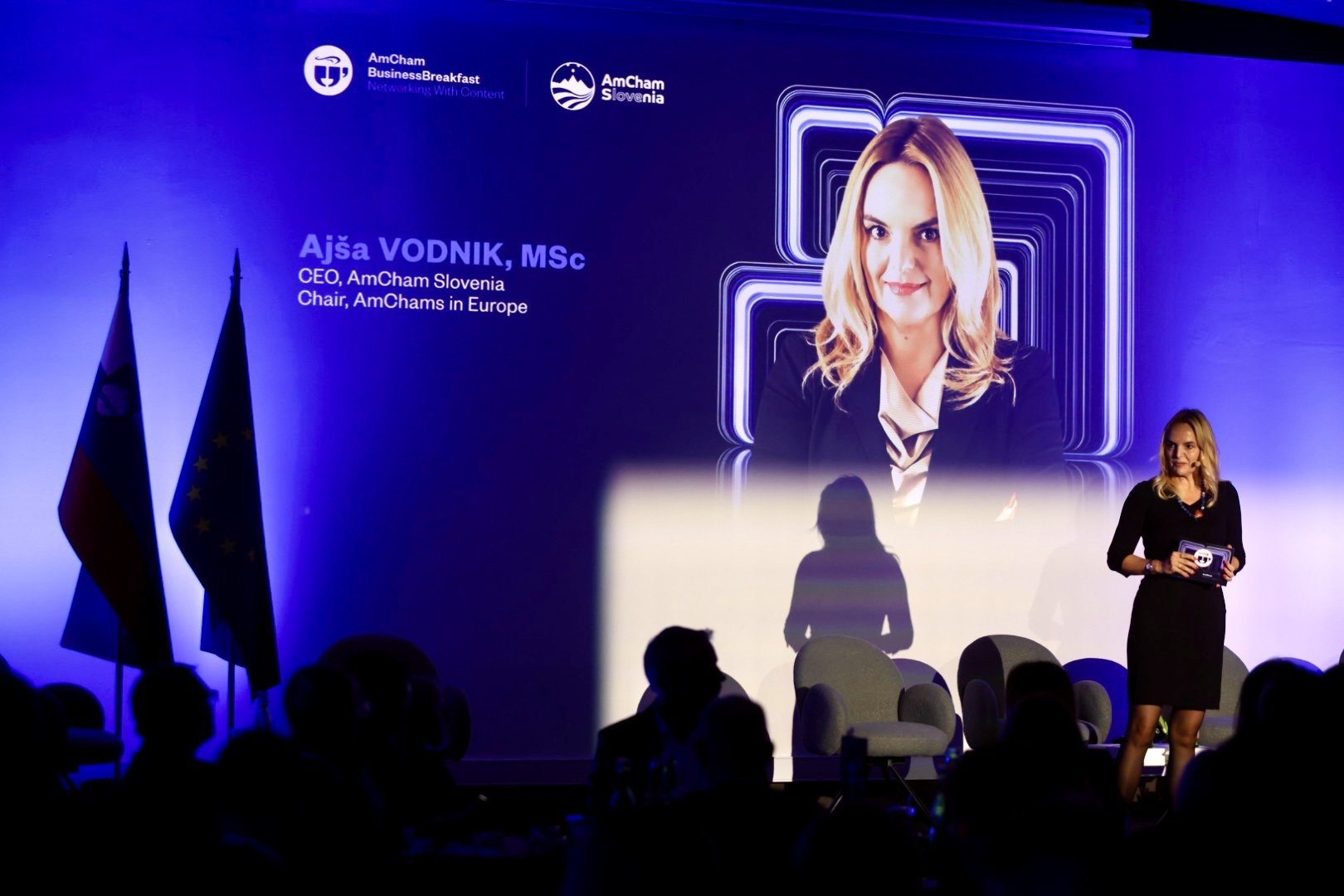
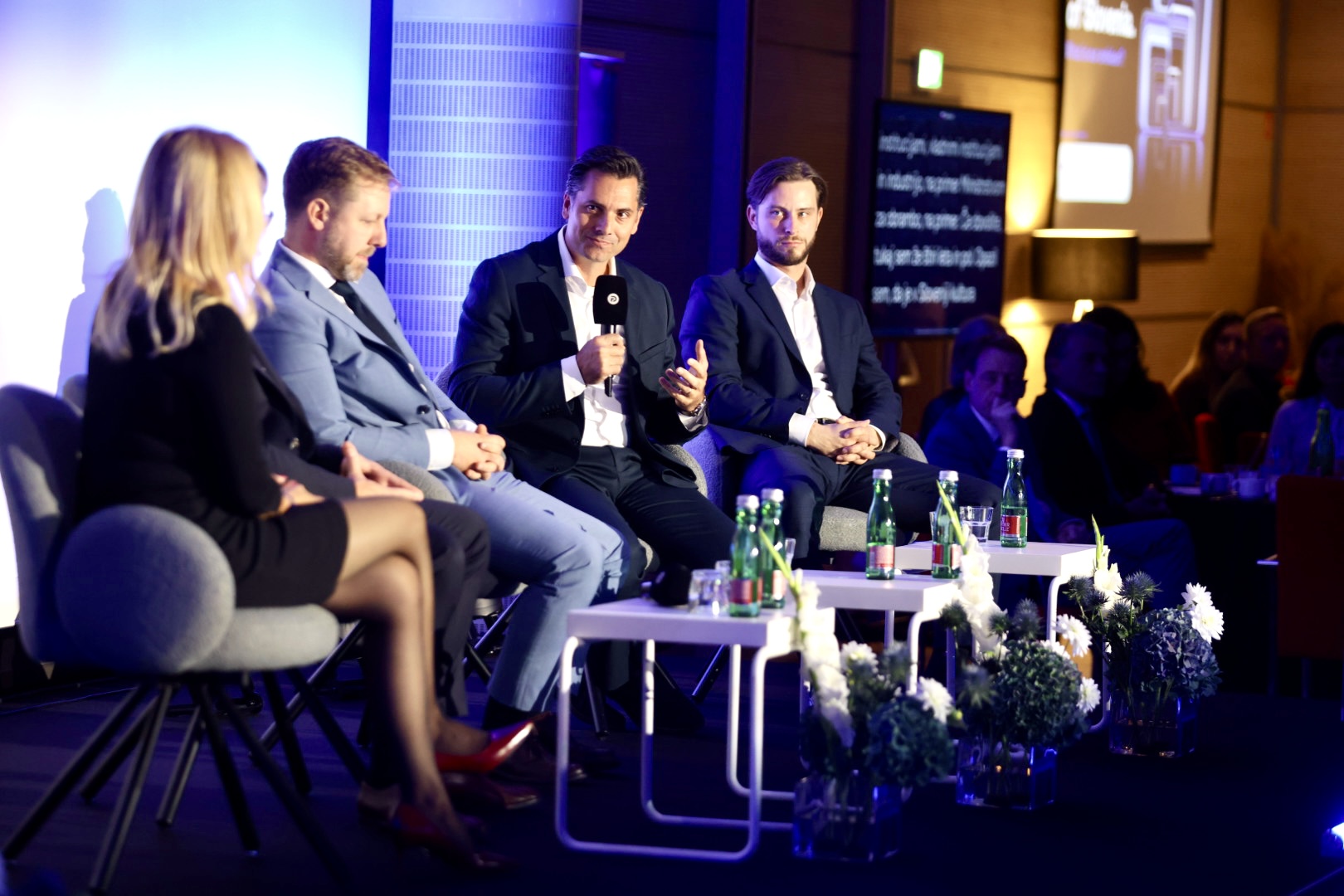
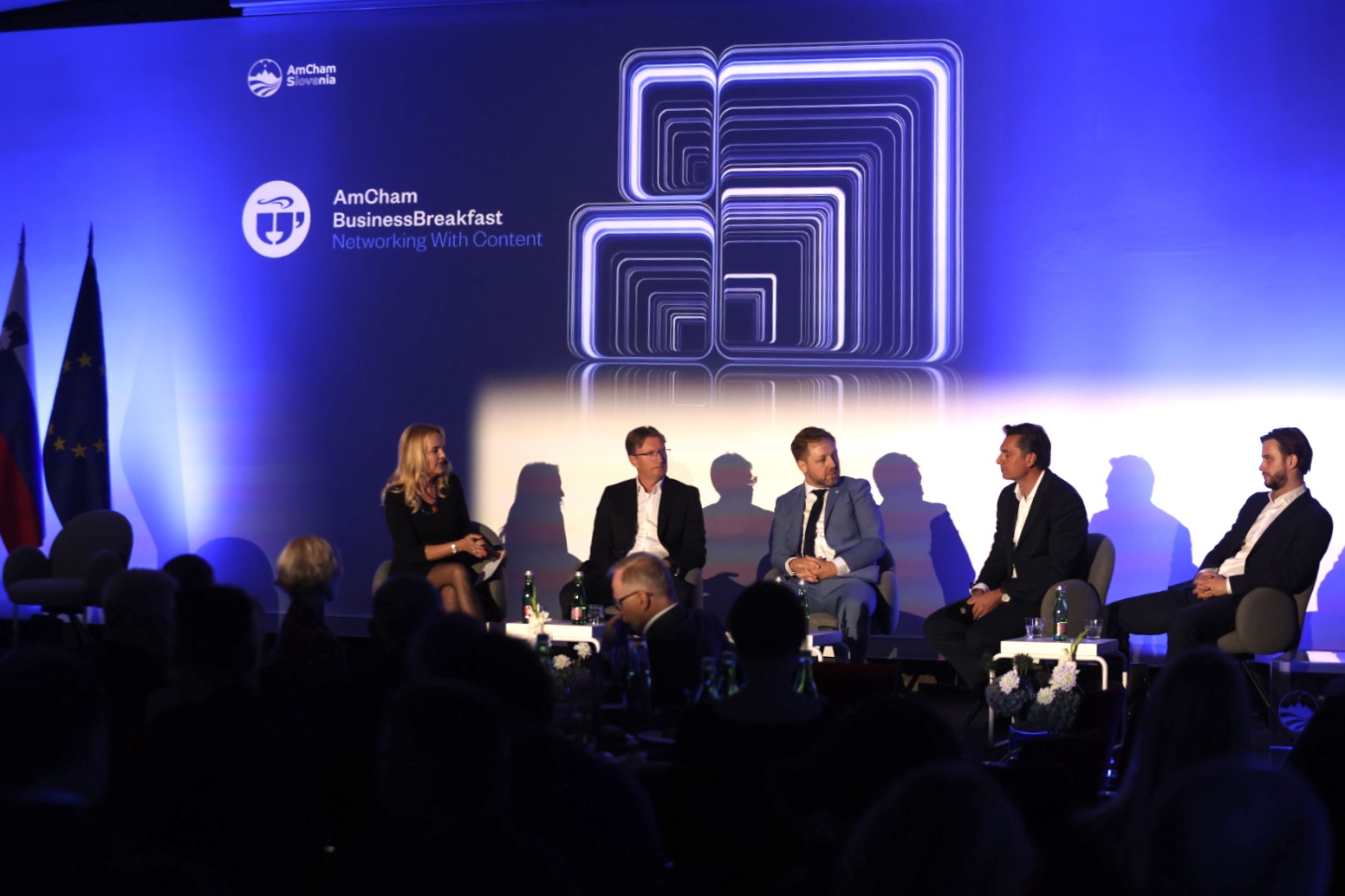
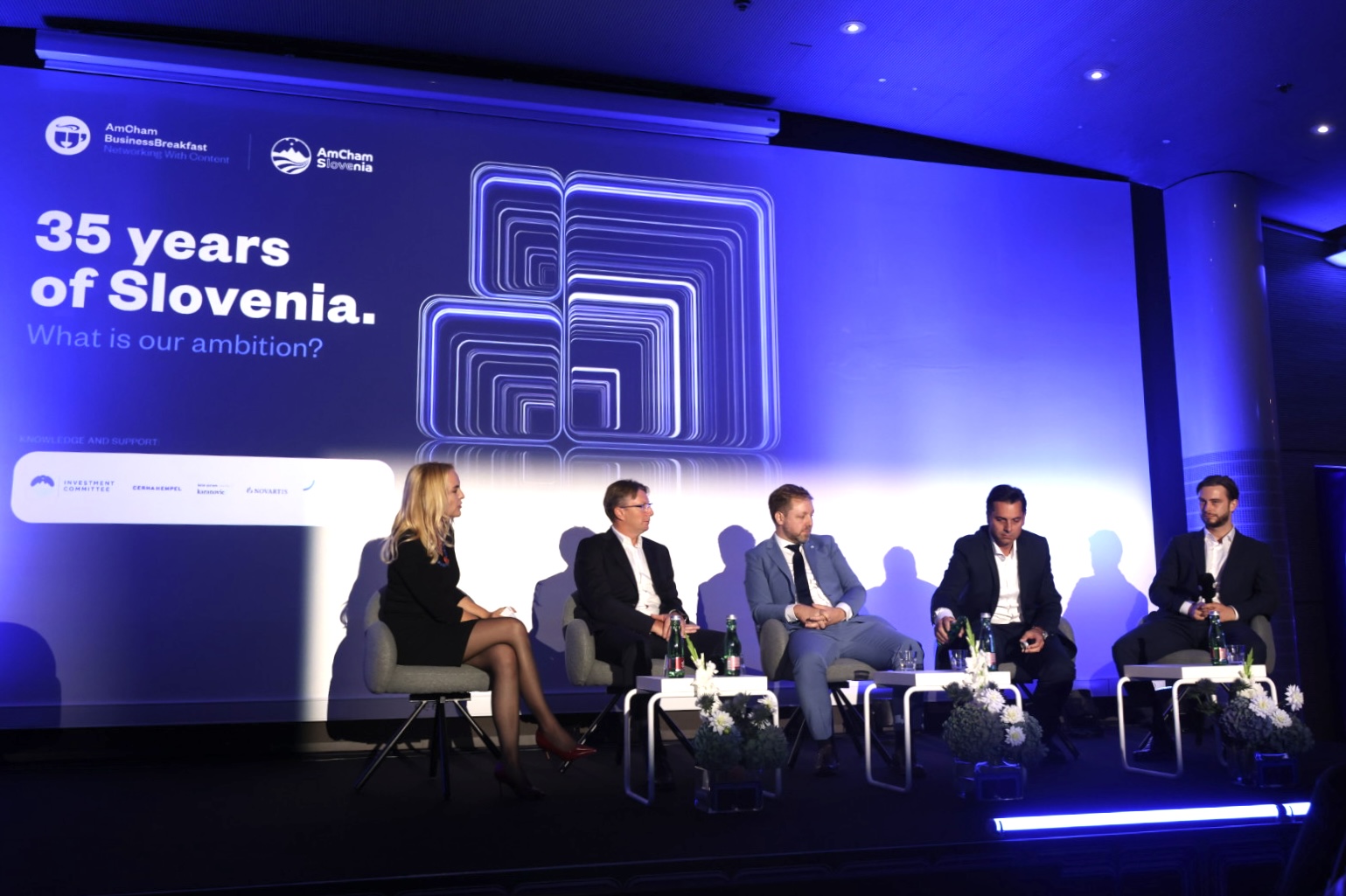
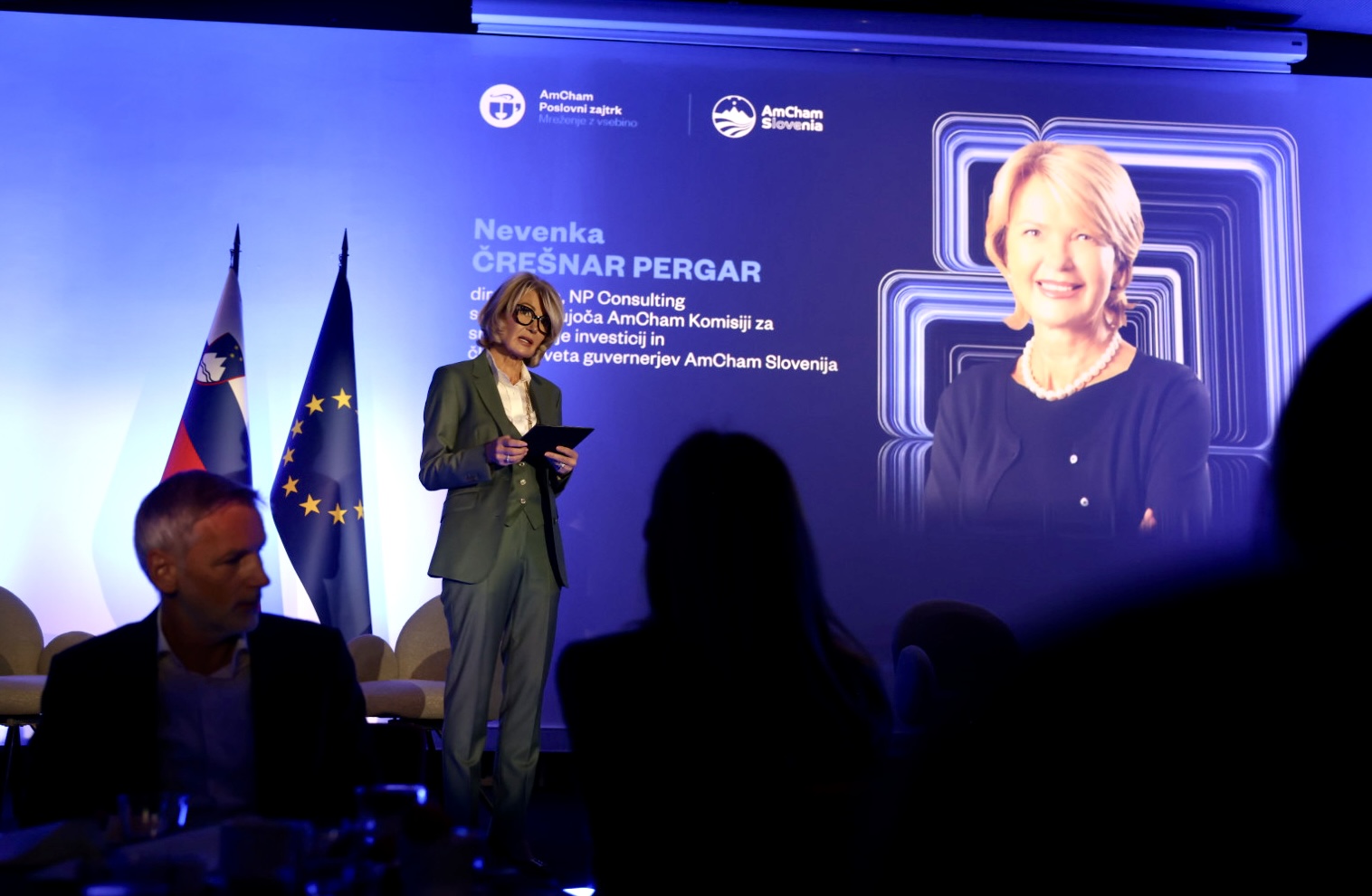
The conversation with the Prime Minister was moderated by Nevenka Črešnar Pergar, a member of the AmCham Slovenia Board of Governors and Director of NP Consulting. The government’s perspective was then compared with the experiences of business leaders and investors: Beno Ceglar, President of AmCham Slovenia and General Manager of NIL; Boštjan Čeh, President of Slovenia BioTech Hills and Head of Business Development at Labena; Gabriel Massey, President and Managing Director of Pipistrel Aircraft; and Michal Maco, Director of Corwin Slovenia. The discussion was moderated by Ajša Vodnik, CEO of AmCham Slovenia and Chair of the AmChams in Europe network.
Ambition is a prerequisite for a development breakthrough
In her opening remarks, Nevenka Črešnar Pergar stressed: “Potential is certainly not the same as competitiveness. That is why today we do not want to talk about how to make minor improvements to Slovenia. We want to talk about how to make it substantially more competitive.”
In the first decades of its independence, Slovenia demonstrated that it could rapidly narrow the development gap and compete with Europe’s most successful economies. Janez Janša recalled that in 2008 Slovenia reached 91 per cent of the European Union average in purchasing power per capita and that, in his words, it remains at a similar level today.
He also attributes this to a loss of development ambition: “Slovenia currently lacks ambition. Many of you are ambitious; we have leading companies with great potential, and we have an ambitious younger generation. Now there is a window of opportunity to put many things right.” He emphasised that individual measures would not be enough without broader ambition: “We need to do things that will take us in a different direction, but we will not be able to do so unless this ambition prevails.”
Competitiveness begins with an environment that encourages success
A significant part of the discussion focused on the tax burden on labour, particularly highly skilled professionals, and on how to create an environment in which companies can compete for the best people and develop high-value-added activities in Slovenia.
Janez Janša emphasised that broader agreement must first be reached on the kind of development environment Slovenia wants to create: “First, we must ensure that we understand what is at stake and what the consequences are. Only then come tax rates and everything else.” He also explained that the Strategic Council for the Economy was finalising some proposals to reduce the tax burden on labour, but that specific solutions had not yet been fully agreed.
For investors, the key word is stability
Stability and predictability were among the strongest recurring themes of the event. Investment decisions are made for the long term, so companies care not only about today’s conditions but also whether they can rely on them several years from now.
Janez Janša noted that the nature of discussions with international investors had changed. Today, he said, one of their first questions is whether adopted changes will last: “The key question is whether you will be able to do this. Will what you do be permanent, or will it still be in place two years from now? In other words, the key word here is stability.”
He continued: “We must also provide a better environment for investment. If we provide a better environment for the domestic economy, that will automatically create a better environment for investment as well, and in a way that is lasting.”
From the perspective of an international investor, Michal Maco particularly highlighted the importance of more efficient building permit procedures, since investors need to know the timeframe within which a project can be delivered. Further investment therefore depends not only on market attractiveness and project quality, but also on clear procedures and greater predictability in project siting and implementation.
This is also one of the core principles of the AmCham Investment Promotion Committee, which identifies stability, predictability, legal certainty and transparency in the business environment as key conditions for attracting domestic and foreign investors.
Less bureaucracy and faster, clearer procedures
The predictability of the business environment is not linked only to taxation. Investors also need clear regulatory frameworks, efficient administration and procedures that enable companies to plan for the long term.
Janez Janša was direct in his assessment of the administrative environment: “We have ended up in an administrative, bureaucratic swamp that cannot be cleared overnight.” He added that the government was seeking ways to reduce bureaucratic barriers and simplify rules.
The AmCham Investment Promotion Committee likewise advocates clear, short and simple procedures, better coordination among the competent authorities, and a predictable regulatory framework.
Talent as one of Slovenia’s greatest competitive opportunities
Another point on which the speakers agreed was people. Slovenia can compete in high-value-added fields only if it can develop, retain and attract top professionals.
Gabriel Massey described talent as one of Slovenia’s greatest untapped opportunities: “One of Slovenia’s greatest opportunities, which we have not yet fully realised, is talent and the possibility of turning it into our competitive advantage. This includes both domestic talent and attracting talent from abroad, for which we must create the right conditions.”
Boštjan Čeh also stressed the importance of suitable conditions: “I would certainly highlight access to talent in Slovenia and neighbouring countries as one of our key advantages. We are just the right size as a country. Why shouldn’t talented people come to work in Slovenia instead of Slovenians leaving to work in other countries? We must create the right conditions.”
For highly skilled people, decisions are shaped not only by salaries but also by the overall conditions for work and life, the supporting environment, and the speed of procedures. Boštjan Čeh also drew attention to the lengthy procedures for employing professionals from non-EU countries, which can cause Slovenia to lose a candidate in the meantime.
Competing not through scale, but through knowledge and added value
According to the speakers, Slovenia has the knowledge and expertise on which to build its future competitiveness in fields such as biotechnology, digital technologies, artificial intelligence and aviation.
Slovenia BioTech Hills is important for Slovenia because the country has a rare combination of everything needed for a breakthrough in biotechnology: world-class expertise, a strong research environment, entrepreneurial courage and growing investment. Nearly one billion euros in investment over the past five years and more than €100,000 in added value per employee demonstrate that biotechnology is no longer a niche activity, but one of the country’s most promising development opportunities.
“I see the greatest opportunity in Slovenia becoming an environment where research is transformed more quickly into globally successful products and companies. We have the talent, knowledge and agility of a small country. If we connect science, business, capital and a supportive regulatory environment even more effectively, Slovenia can become an internationally recognised biotech hub that not only creates high added value but also develops solutions to the greatest challenges of the modern world, from healthcare to sustainable development. Slovenia BioTech Hills is a platform that can bring this potential together in a shared story and present it to the world,” Boštjan Čeh emphasised.
Beno Ceglar placed knowledge and people at the heart of long-term competitiveness: “Our key asset is knowledge. It is talent; it is people. Everything begins and ends with people.”
He also highlighted digitalisation and artificial intelligence among the key opportunities, along with the need for stronger connections among different initiatives, companies, government, and educational and research institutions. In his view, an open ecosystem could also link Slovenia more closely with global technology companies and investors.
From potential to decisions
Slovenia offers a high quality of life, knowledge, a geostrategic location, a developed industrial and research environment, and companies that already compete successfully in global markets. The discussion showed, however, that these strengths must be accompanied by a predictable and stable business environment, efficient procedures, competitive conditions for work and investment, and the ability to attract talent and capital.
These are precisely the areas at the centre of the AmCham Investment Promotion Committee’s priorities: a stable and predictable environment, legal certainty, transparency, fewer administrative barriers, and carefully considered legislative changes developed through dialogue with the business community.
In closing, Ajša Vodnik, CEO of AmCham Slovenia, emphasised that the AmCham Slovenia business community cannot imagine Slovenia’s future without cooperation among business, government and civil society:
“If we want to create the Slovenia we envision for 2035, we must first believe that we can create it together. We need the courage to pursue great ambitions, open dialogue among all stakeholders, and an awareness that the future is the responsibility of us all.
Let us imagine Slovenia in 2035 as a European centre of SI, not only because .si is our national domain, but because SI stands for Super Intelligence, Science and Innovation. A country that comes first to mind globally when people speak of biotechnology, breakthrough innovation, and world-class research and development.
Slovenia can be a place where solutions to global challenges are created, where the best talent wants to live and work, and where investment, knowledge and entrepreneurial energy arrive from around the world. At the same time, we must preserve what makes us unique: high-quality public education, accessible healthcare, strong social security and a high quality of life.
Our competitiveness must not be based on becoming like others, but on developing our own strengths. We must prove that a society can combine economic success with care for people. This can be Slovenia’s greatest advantage and the reason it becomes an inspiration to other European countries as well.”
After 35 years of Slovenia, the question is therefore no longer only what we have achieved as a country. The question is what our ambition is for the next decade and whether we are ready to create the conditions to realise it.