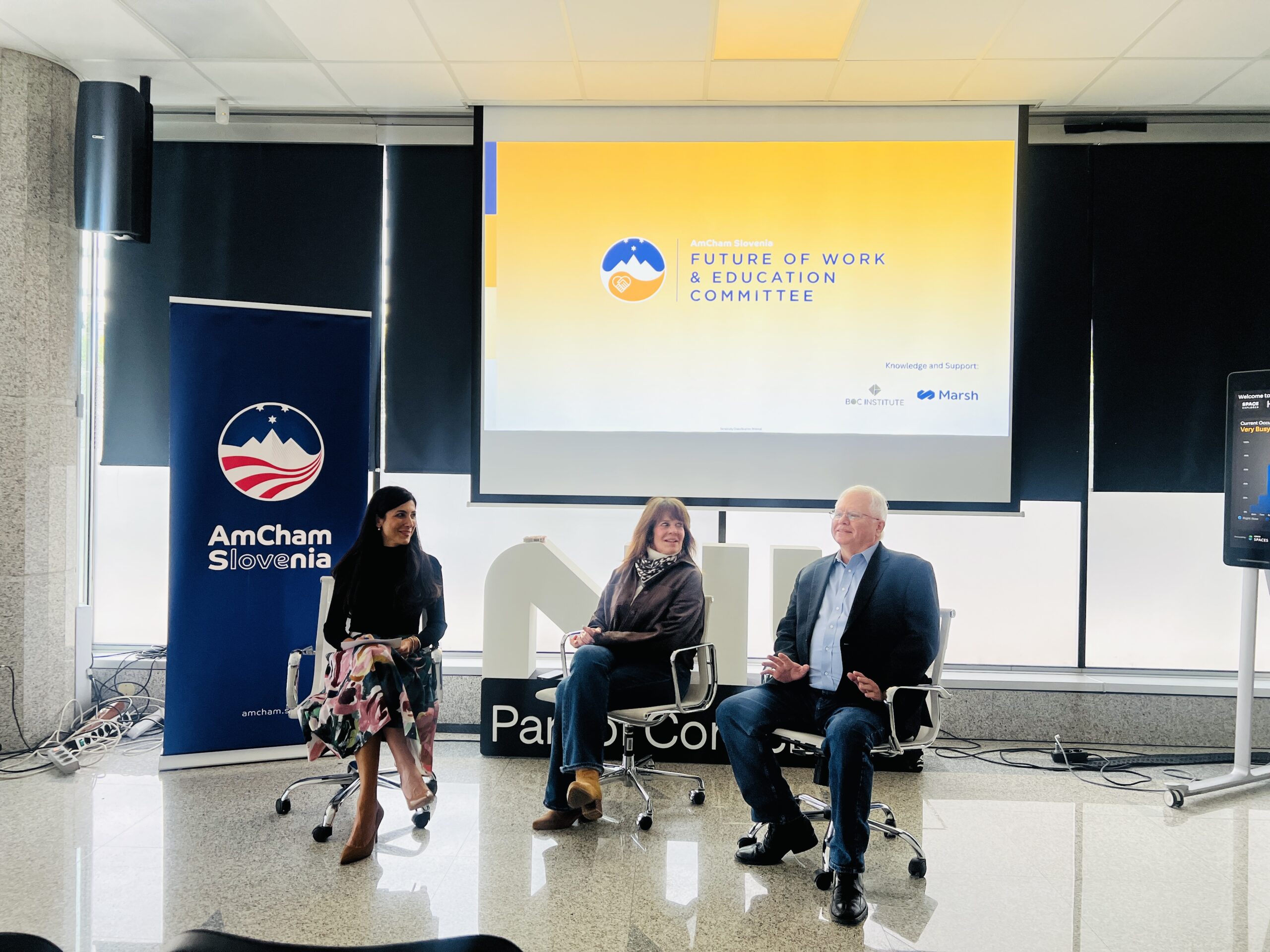


This was the key message that shaped the latest meeting of the AmCham Slovenia Future of Work & Education Committee, hosted by NIL.
Together with our guests from Cisco, Peg Nicholls, Senior Director, Cisco Learning and Certifications, and David Mallory, Senior Director, Learn with Cisco Engineering, we explored how organizations can ensure that employees’ skills evolve as quickly as technology itself and how competency development can be aligned with real business needs.
The speakers emphasized that learning is increasingly becoming part of everyday work. Knowledge is no longer something we acquire at the beginning of our careers and then rely on for decades. Instead, it must be continuously developed, refreshed, and applied in practice. They highlighted the 3E model (Education, Exposure, Experience), which places particular importance on hands-on experience, while also stressing that even the most advanced tools cannot create value without strong foundations and quality expertise.
Special attention was devoted to artificial intelligence. While AI enables faster access to information and new ways of learning, it also increases the importance of critical thinking. In a world where answers are available within seconds, understanding how information is generated, how to verify its accuracy, and how to use technology responsibly and effectively becomes even more important. The speakers agreed that the ability to evaluate information, understand context, and connect knowledge across disciplines will be among the most important skills of the future.
Additional inspiration came from prof. dr. Andrej Kos of the Faculty of Electrical Engineering, University of Ljubljana, who demonstrated how collaboration between academia and industry can help students tackle real-world challenges. He presented a multidisciplinary program focused on solving complex problems, where students from different faculties work in teams alongside mentors and industry partners to develop solutions for concrete business and societal challenges.
Based on real-life challenges, cross-disciplinary collaboration, and the development of prototypes and practical solutions, the program gives students valuable opportunities to translate knowledge into practice while strengthening competencies such as collaboration, systems thinking, creativity, and innovation.
One of the key takeaways from the discussion was that in the age of artificial intelligence, we may need human-to-human collaboration, knowledge sharing, and learning from one another more than ever. Technology is evolving at extraordinary speed, but curiosity, critical thinking, and a commitment to continuous learning remain the competencies that will matter most.
The meeting was moderated by Sanja Savič, Co-Chair of the AmCham Slovenia Future of Work & Education Committee.