Who really connects people within an organization? Who do employees trust? Who do they turn to when they need help? And who can turn a new idea or change from a pilot project into everyday practice?
At the meeting of the AmCham Future of Work and Education Committee, held on November 12, 2026, we explored two topics that may seem different at first glance but are closely connected: Organizational Network Analysis and the implementation of artificial intelligence in HR processes. Both share a common focus: people and understanding how organizations actually work.
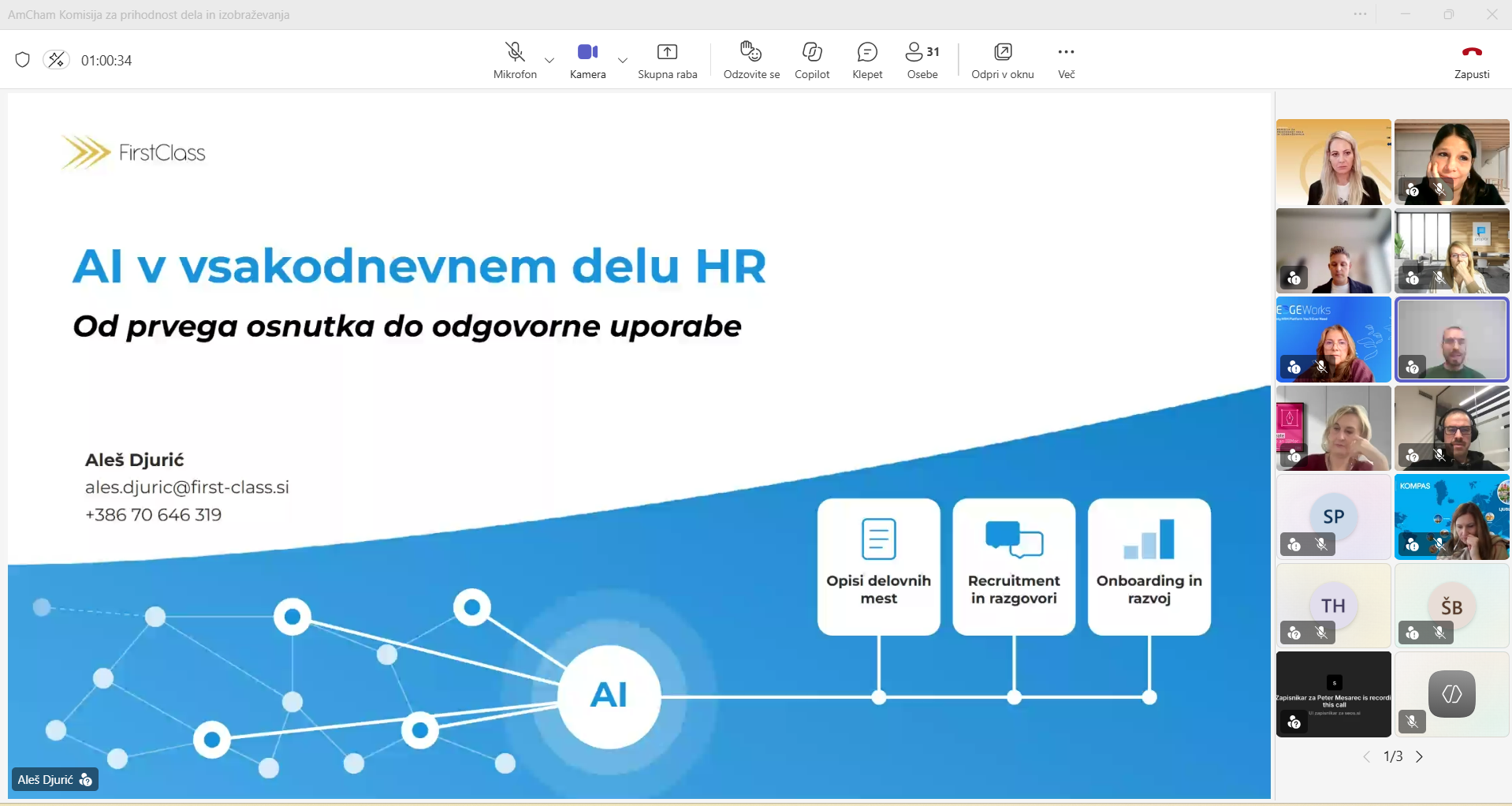
We were joined by Rok Koželj, CEO of Quantifly and Holder of Procuration at First Class, and Aleš Djurić, Senior Consultant and Key Account Manager at First Class.
An Organization Is More Than Its Organizational Chart
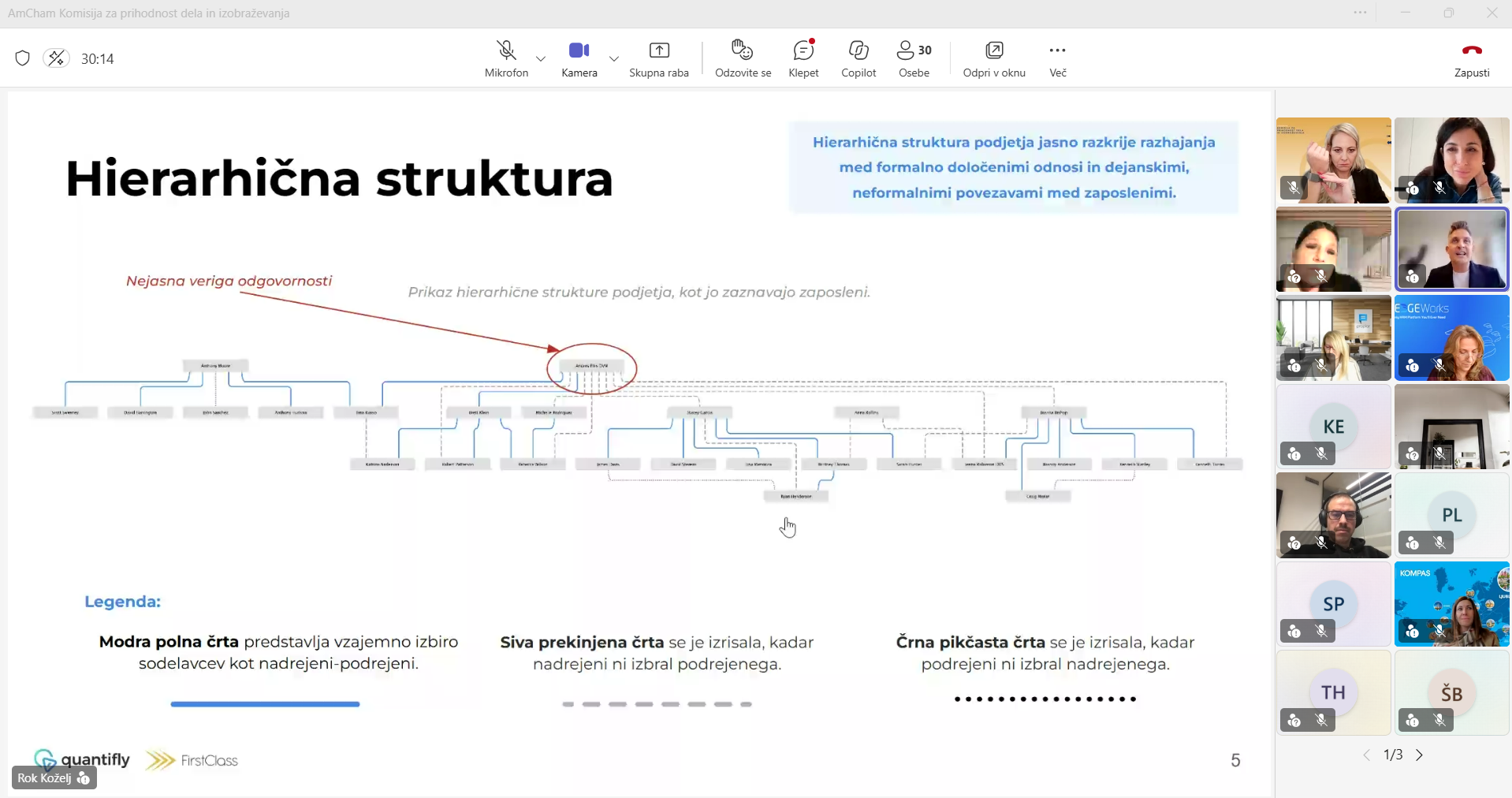
A formal organizational structure tells us who reports to whom and how responsibilities are distributed. What it reveals far less clearly is who actually holds influence within the organization, who connects teams, where communication bottlenecks emerge, and whom employees truly trust.
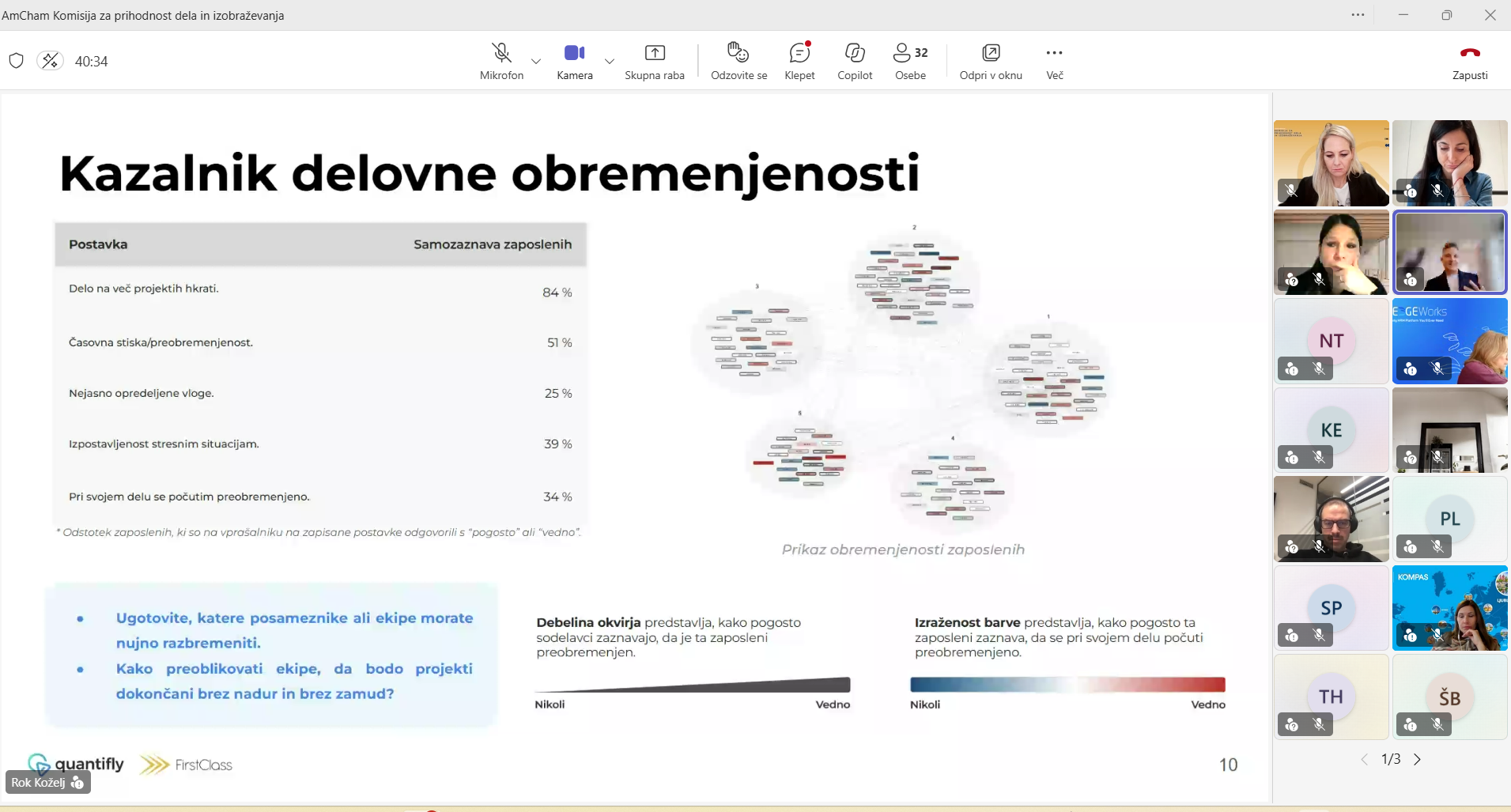
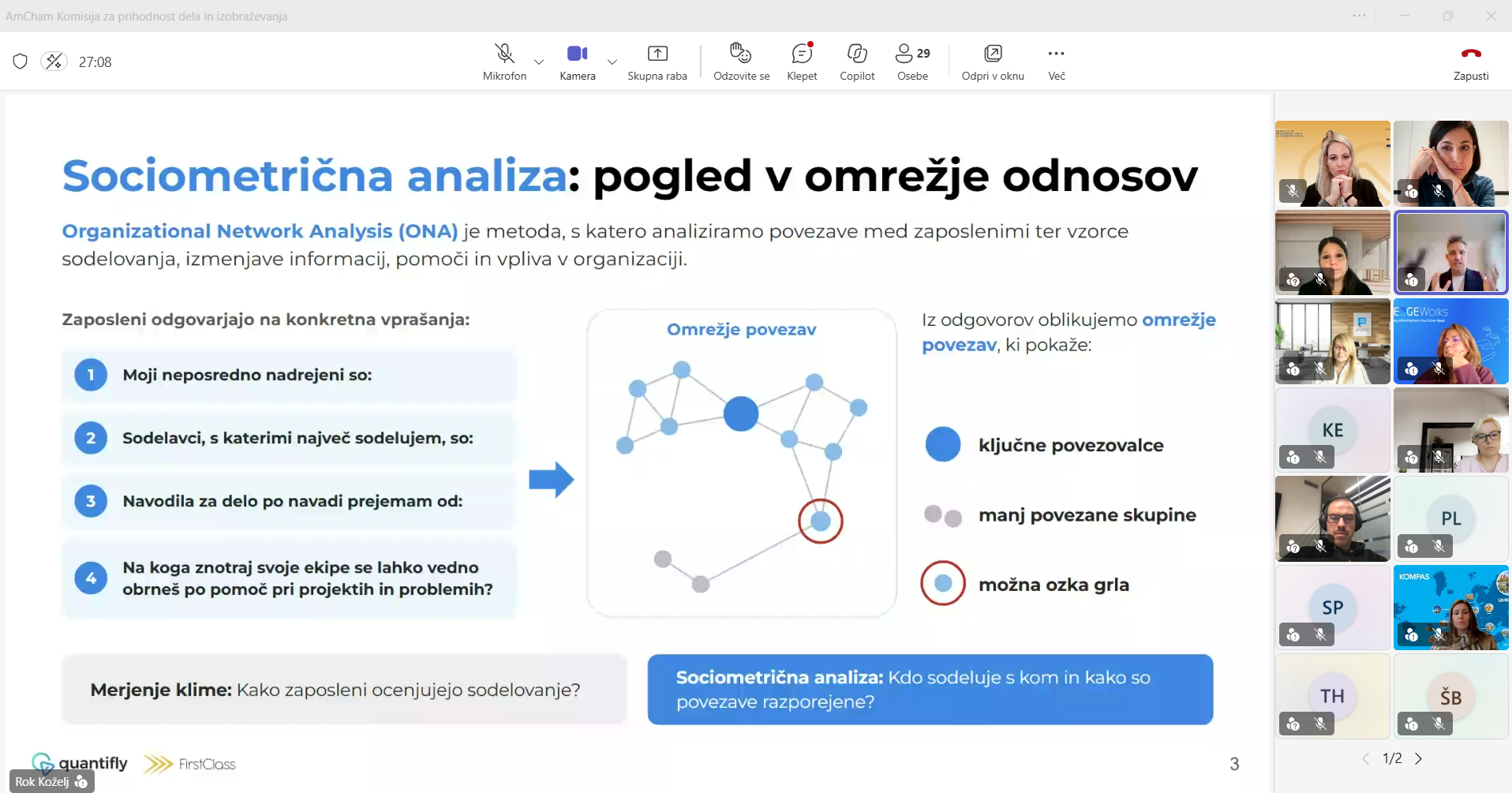
Rok Koželj introduced sociometric analysis, also known as Organizational Network Analysis (ONA), a method that helps organizations better understand informal relationships among employees.
By asking questions about collaboration, trust, guidance, support, and the flow of information, organizations can map relationships and uncover a picture that may differ significantly from the formal organizational chart.
Such insights can reveal:
- Informal leaders and key connectors.
- Individuals through whom a significant amount of information flows.
- Communication silos and bottlenecks.
- Differences between formal leadership structures and how leadership actually functions.
- Key individuals who are overloaded with responsibilities.
- Employees with significant influence or potential who may not yet be recognized within the formal structure.
However, collecting data is only part of the process. What truly matters is how that data is used. Analysis only creates value when it is followed by meaningful conversations, appropriate actions, and feedback to employees.
From Understanding Relationships to Implementing AI
The introduction of artificial intelligence is a clear example of organizational change where formal structures alone are not enough.
AI is not simply a technology or IT project. It is also about changing the way people work, and HR plays an important role in that process.
Successfully integrating new technology into everyday work involves much more than selecting the right tool. It also means understanding who should be included in a pilot group, who can become an ambassador for change, who connects different parts of the organization, and who has earned the trust of their colleagues.
Insights from Organizational Network Analysis can be particularly valuable in this context. They help identify people with influence and strong connections, as well as those who are willing to ask challenging questions. A diverse group of individuals can provide the strongest foundation for a successful pilot project and the subsequent wider adoption of new ways of working.
Let AI Handle Routine Tasks, While People Retain Judgment
In the second part of the meeting, Aleš Djurić focused on practical applications of artificial intelligence in everyday HR activities.
Drawing on his own experience, he demonstrated how AI can support interview preparation, note-taking, document management, and summary creation, saving approximately 30 minutes per interview, or around five hours per week.
But the real value goes beyond saving time.
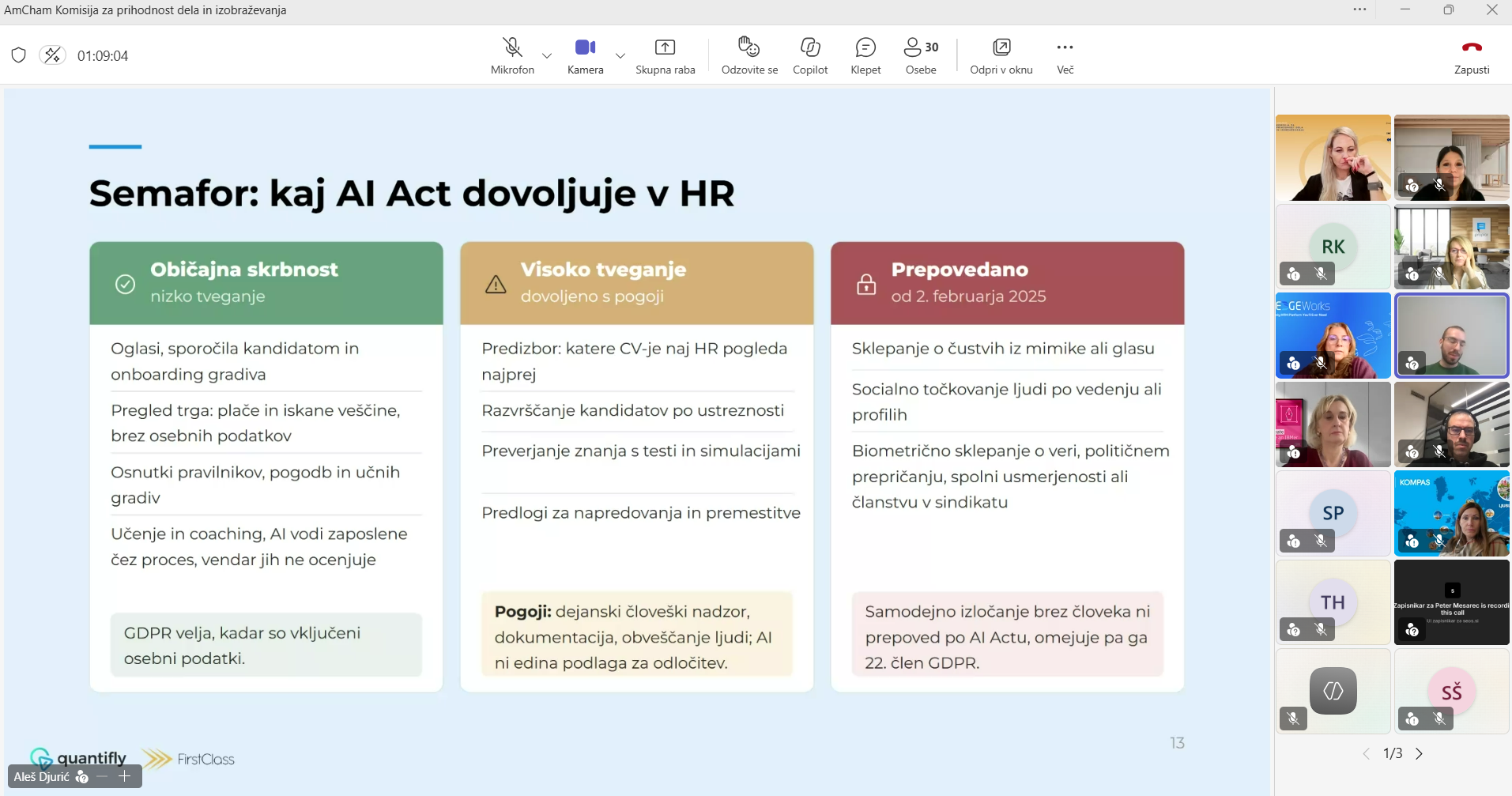
AI can take over some operational and repetitive tasks, while understanding context, taking responsibility, building relationships, and making final decisions must remain in human hands.
This is why introducing AI should not begin with purchasing a software license, but with a specific question: What will an employee be able to do differently or better tomorrow as a result of using AI?
A good starting point is a single, clearly defined, low-risk task, followed by a pilot involving a small group of users, measurable results, and several rounds of refinement before the solution is rolled out more widely. This process requires collaboration between HR, management, IT, and experts in legal matters and personal data protection.
More Technology, More Space for People
Perhaps the most important takeaway from the meeting was, in fact, a deeply human one.
If better data helps us understand how an organization truly operates, while artificial intelligence takes over some routine tasks, we can devote more time and attention to what matters most: meaningful conversations, active listening, developing people, and building trust.
And trust remains one of the essential ingredients of any successful change, whether it involves organizational restructuring, new ways of working, or the introduction of artificial intelligence.